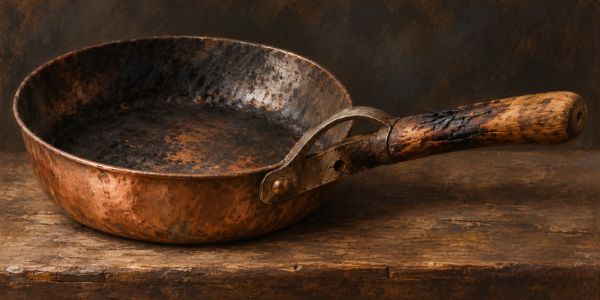
One day, while aimlessly walking the streets, he saw his uncle Louis, who had returned from England to try and find members of the family who might still be alive. He told Haim that his parents, Samuel and Pearl and his sisters Sarah and Sophie had not survived the camps. However, with the assistance of the Municipal Council and the Jewish Assistance Agency he had been able to reclaim their family home on Via del Tempo, where Haim still lived.
All of this had been difficult for him to speak of, and he paused for several moments before regaining his composure. When I asked what his occupation had been, he said he was a custom tailor, following in a family tradition begun over 100 years ago.
Pointing to the shop where I had bought the patelnye, he told me it had been the location of his family business, which at one time produced the finest handmade suits in Rome. Their clientele included government officials and various members of the Vatican Council. Regrettably, he had to retire when he became afflicted with involuntary hand tremors, and no family member was interested in carrying on the tradition.
He never married, but remained in close contact with his nephews and nieces whom he considered as his own children. Unfortunately many had now emigrated to other parts of Europe and North America and he wondered if I knew a niece who now lived in Toronto.
Haim had never completely freed himself from the trauma of his childhood still regularly waking at night with nightmares. He often came to this bench, to sit and to remember and thanked me for listening and showing him the patelnye. It had brought back many memories. Pleasant and otherwise.
After hearing his story, I decided to offer him the patelnye. According to Jewish law, if someone loses an item, they continue to own it, even when it’s not in their possession and I felt it would certainly be more meaningful to him. He was surprised at my gesture, and when he asked what I planned to do with it, I told him I would place it in front of our fireplace, where everyone could see it. He thought for a moment, then nodded his head saying that’s where it now belonged, where people could see it and be told of its background. In that way it would provide a sense of what Jews in Italy had experienced during the war.
Aided by his walking stick, he slowly rose from the bench, embraced me with a strong hug and said “abee gezunt “– be healthy. I asked if I could send him a picture of the patelnye when I got home, but he said he didn’t have email. As he slowly walked away, I wondered if we were meant to meet. Was the patelnye destined to come home with me? Could it have been one of the many left on the train platform? These and other questions remained unanswered, but suffice to say I was very protective of the patelnye throughout the remainder of our trip.
After arriving home and before placing it in front of the fireplace, I decided to try and repair the broken rivet. I examined the spot on the patelnye and lightly scratched beside the rivet were the initials SPG – Samuel Pearl Gentner? Haim’s parents? He had certainly seen them, but perhaps had chosen to provide the patelnye with a new life and I decided not to repair it. It was now no longer simply a rivet on a patelnye, it was a symbol of mans’ inhumanity to man and an example of one person's resilience and determination. I sent him a picture of it in its new place addressing it simply to Hiam Gentner, Via del Tempo, Rome, Italy. I like to think he received it.