I would guess that you started to read this story in part because you were either intrigued with its title, and have no idea what a patelnye is, or you were drawn to it after reading my previous submissions. I strongly suspect it was the former as I have no illusions about the latter. Full disclosure. Until a short time ago, I had never heard of the word.
Now that I’ve piqueded your interest. I’m going to keep you in suspense just a little while longer. Not too long.
The first time I saw a patelnye, it was on the floor beneath a shelf overflowing with books in a Judaica store in the old Jewish Quarter of Rome, Italy. It was not the reason I entered the store, but it immediately caught my eye.
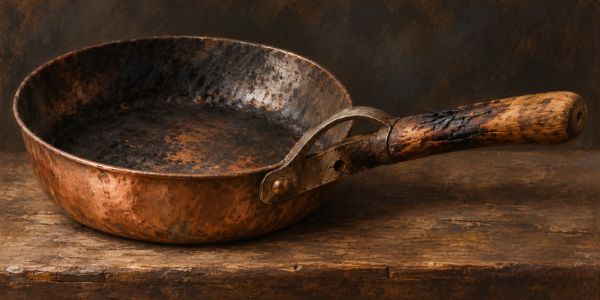
It just didn’t seem to fit in and appeared to be an afterthought, as if there was no other place to put it. It was an intruder. Like a field worker who wandered into a formal dinner, or a brown suit at a black-tie event. It was an old copper frying pan, which in Yiddish is a patelnye.
Its wooden handle showed the scars of being held too close to many flames. There was a small strip of metal attached to the base of the handle that arched to the other side, attached by two metal rivets, one of which had broken away from the frame. The inside of the pan was completely blackened with the copper tone on its bottom barely visible. All this simply enhanced its character, which is more than could be said for most of the other items in the store. Several were attractive, very colourful and certainly sellable, but this pan, obviously old and well used, was, at least in my eyes, the jewel of the shop.
If it’s possible to connect with inanimate objects, I did so with this pan. It linked itself to that part of me that finds beauty and meaning in older objects. The part that’s fascinated by their history, who owned them, when and what they were used for! I couldn’t leave it behind. If there was a reason I had entered the shop, it was to buy that pan.
Common sense, an often unwelcome visitor, began to seep into my thoughts, as it occasionally does, often depriving me of taking the road less travelled. Now it was whispering that it was only day two of the 12-day bike ride we planned through Tuscany and the surrounding countryside, so how could I pack it and keep it in one piece? It was too odd-shaped to fit into hand luggage. Logic won out. Temporarily. I asked the owner its price, and after thinking about it for a moment, she suggested one I’m certain was made up on the spot. I thanked her, left the store and returned to the nearby café, where my family was having lunch and told them about the pan. Judging from my tone, they likely knew how this scenario would end. Not wanting to disappoint them, I left before finishing my meal and returned to the shop. After some half-hearted bargaining, the pan was mine. As it was destined to be.