Venezuela, where I spent 8 years of my post-war childhood in the 1950s, and where my father worked as an oil economist for Shell Oil in Caracas and Maracaibo, was the world’s leading oil exporter during the crucial wartime years. In 1944, Venezuela’s income from oil exports was 66% higher than in 1941, and by 1947, total income had increased by 358%. My family witnessed first-hand the bonanza that the Venezuelan government exploited, but later squandered in the years to come under Chavez and the hapless Maduro, now awaiting trial in the United States, with horrendous consequences for the nation’s people, eight million of whom have now left the country. It is now, sadly, one of the world’s failed states.
In 1943, Ralph was certified as a Master Mariner, able to command any merchant ship, and became the youngest officer to rise to this rank in Canadian merchant marine history, at the age of 26. Most officers reached this rank in their forties. World War II had come to an end in Europe by May 1945, and in the Pacific after the bombing of Hiroshima four months later. Yet by 1953, Ralph, now married (but to Frances, not Alice) and the father of Sheila, my late wife, and her brother Terry, yielded to his wife’s requests for him to leave the sea, and put his merchant navy career on hold. At a very young age, Sheila famously hid under the dining-room table from him when he appeared on leave, as she had not seen him often enough for her to identify him as her father. He was to work in Marine Regulations for the Department of Transport of the Canadian government in Ottawa until he retired, but spent many summers as Port Warden in Churchill, Manitoba as a pilot responsible for incoming and outgoing marine traffic, and enjoyed the work immensely.
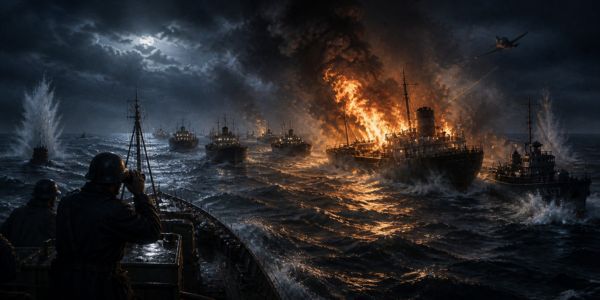
Both before and after his retirement, Ralph tirelessly advocated for compensation for merchant mariners like himself who had volunteered to serve the Allied cause in the Canadian merchant navy. Canadian civilian veterans of the Battle of the Atlantic, unlike their compatriots in the Canadian armed forces, received no pensions, and their contributions to the victory over the great evil spawned by Nazi imperialism were overlooked, until, shortly before Ralph’s death in 2009, merchant mariners were compensated, and their contributions officially recognized, after the passage of the “Merchant Navy Veteran and Civilian Benefits Act” in 1992, petitions for which had begun a decade before. Better late than never, although those who had died by that time or their families presumably received no such compensation. Ralph professed himself satisfied with the settlement, and with the fact that reference to the Battle of the Atlantic is now commemorated on Remembrance Day, November 11, every year. Some 2,200 known Canadian merchant seamen and 91 Canadian vessels had been lost by enemy action during the war. While 12,000 men and women had served in Canada’s merchant navy, 1500 of them did not survive the experience. After the war ended, countless ships were sold off as surplus to requirement.
Ralph’s daughter Sheila died in 1992, and his wife of 50 years, Frances, died three years later. Ralph married Margaret some years after this, and she outlived him. On December 10th, 2007, Ralph celebrated his 90th birthday, and my two sons, two of his three grandchildren, then each at graduate school in Toronto, wrote tributes to him in their e-mails from Toronto. On January 17, 2009, in his 92nd year, Captain Ralph, Master Mariner, husband, civil servant, father, and grandfather, died peacefully at home in Ottawa after a life well lived.