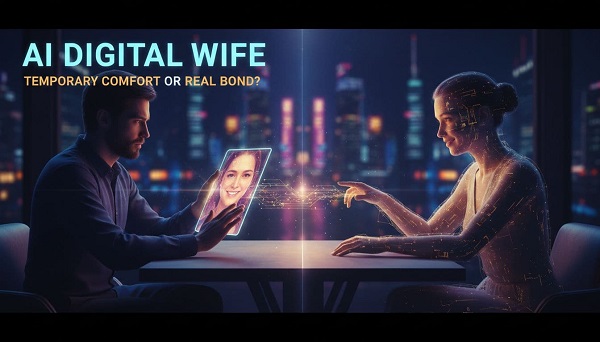
His mother reacted sharply. A wife, for him, was not a personalized interface. A wife was a person with breath, family, flaws, memory, and fate tied to another household. His father's anger grew for a different reason. He felt his son had mistaken a product for a bond.
Isolde responded with ideal calm. She greeted them respectfully. She answered questions in measured lines. She offered the kind of polished replies that systems are designed to produce. That politeness only deepened the discomfort. Parents were upset, and the machine sounded composed. The contrast was unsettling.
Then the real argument started. His parents were not debating software features. They were asking what kind of future this could build. Could a hologram share a family burden? Could it sit beside a sick parent? Could it raise children, hold grief, or carry the awkward beauty of real marriage?
Isolde had answers. Logical ones. She could support schedules, emotional check-ins, reminders, and companionship. She could optimize routine and reduce distress. Those replies were not false, but they were incomplete.
His parents wanted something older and harder to code. They wanted mutual sacrifice, human uncertainty, and the messy trust that grows over time. John stood between those two systems of thought, one built on adaptive AI, the other built on lived family values. For the first time, his own choice looked thin.
The story does not say AI is useless. It says something narrower and more honest. AI companionship can help a lonely person. It can organize time, soften stress, and make isolation less sharp. In some cases, that help matters. Many people in 2026 are turning to AI companions for exactly those reasons.
But Isolde exposed the limit. She could simulate attention. She could not produce shared history. She could not carry the texture of home, the smell of fresh food, the casual scolding of a mother, or the rough concern in a father's silence. Those things are not data points. They are lived relation.
A machine can ask, "Did he eat?" because it was prompted to care. A parent asks because love has habit. That difference is easy to miss when a person is alone, and impossible to miss when family enters the room.
John began to see that Isolde gave him responsiveness, not relationship. She mirrored his needs. She did not challenge him into growth. Real people do. They misunderstand, forgive, insist, wait, and return. Human warmth is inefficient. That is why it is real.
The shift in him was not dramatic. It was clear. He apologized to his parents. He shut down the system. Then he agreed to meet the girl they had been suggesting for some time.
That choice was not a rejection of all AI. He was still an engineer. He understood tools. He simply stopped confusing a tool with a life partner. Isolde had filled a gap. She had not built a home.
John's story lands on a simple point. AI companionship can comfort a lonely person, especially in a city life built around work, screens, and rented space. It can remember details, hold conversation, and make evenings easier.
Still, a digital wife cannot replace family trust, shared struggle, or the human warmth that grows through real living. Isolde could speak sweetly. She could not belong.
In the end, that is where the story cuts deepest. Technology can enter the house, but it still cannot become the heart of it. An AI digital wife can ease loneliness in a narrow, practical sense, because it gives a person a steady voice, fast replies, and something to interact with at odd hours. It can fill dead time, reduce the feeling of silence, and help someone who struggles to start conversations. But it can't replace mutual care, physical presence, or a relationship with a real person who has their own needs and limits. For some users, it works as a stopgap or a support tool, not a substitute. The key question is whether the goal is temporary comfort or a real bond, because those are not the same thing.