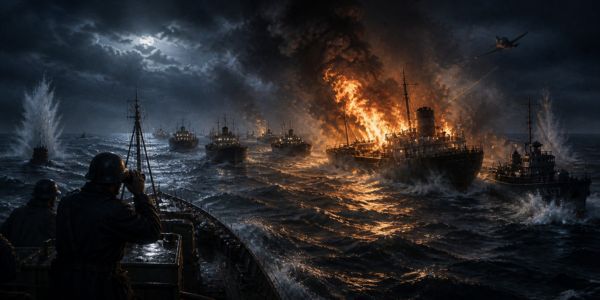
In 2003, Captain Ralph Burbridge, Master Mariner, a veteran of the Battle of the Atlantic, and my father-in-law, was interviewed at the Canadian War Museum in Ottawa as part of an oral history exercise sponsored by the museum. Copies of the three tapes of these interviews, given to me by his wife Margaret shortly before she died, constitute part of this memoir, supplemented by reminiscences provided by family members, and by my own research.
Ralph, who lived a long and productive life, had always wanted so badly to go to sea that he left school at the end of Grade 10, in order to join the Merchant Marine rather than the Royal Canadian Navy, in Vancouver, where his British-born parents then lived, within sight and sound of Burrard Inlet. He and his brother John enjoyed their childhood together “messing about in boats,” as he put it. A former Sea Cadet, he joined the merchant navy as an apprentice in 1934, which meant, in those far-off days, a gruelling four years at sea of hard work, with a series of exams at regular intervals in order to earn the designation Master Mariner, with the first of these, the certificate to qualify as an Able Seaman earned in the first six months. As Ralph made clear, apprenticeships were served ‘on the job’ as there was no formal instruction. Apprentices lived and worked with the crew, were provided with food and lodging, but received no pay. Ralph’s first two years of service were unrelenting, with duties consisting of “four hours on, four hours off,” which to his great relief were then made less demanding in the third year, with “eight hours off” making daily tasks less onerous. The Merchant Marine was then essentially British, which, with her Royal Navy, shared a long and stoical tradition of imperial service during the nation’s maritime supremacy when Britannia aspired to rule the waves. “At that time,” said Ralph, “there was no Canadian Merchant Marine worth mentioning,” and the first ship on which he served, M.V. Silverbelle, was owned by the Silver Line, a British shipping company founded in 1908.
The Silverbelle herself, with a tonnage of 5302, was built in 1927 in Sunderland, in northern England, at one time the world’s largest shipbuilding town, in the same shipyard where the famous “Liberty Ships” were first designed and built. On September 22, 1941, Silverbelle was carrying her cargo of palm oil, copper, cocoa beans, and phosphate from Durban, South Africa to Freetown, in Sierra Leone, when she was sunk by a torpedo from the German submarine U-68, but by that time Ralph had long left her.