In the Canadian Army Reserves, I was a corporal. We were a reconnaissance regiment at the time, although, I understand that now the Elgin Regiment has been changed to a Combat Engineer Regiment. The regiment is still located in St. Thomas, Ontario. But during my time in the unit, I was a reconnaissance soldier.
Reconnaissance training was always interesting. Primarily, we did combat operations from moving, armed, vehicles. But it also incorporated infantry training, internal security training, map and radio use and directing artillery from observation posts. Basically, any role you would look to a soldier to perform, the reconnaissance soldier was trained to do.
The following is one training exercise done at Camp Ipperwash what was, at the time, a military base on the shore of Lake Huron south of the Pinery Provincial Park. The base has since been reclaimed by the Chippewas of Kettle and Stony Point First Nation as land that was expropriated from them in 1941 for military purposes during World War II and not returned until 1995. But during the 1970s, our regiment used this base for training exercises.
I knelt on the edge of the parade square at Camp Ipperwash. There were six of us plus an officer. We had already been briefed on our training mission for that day. A Chinese military advisor, for our purposes a soldier from another regiment in combat uniform with red epaulettes, would be travelling along a road in an unmarked vehicle. Our job was to be air lifted behind enemy lines, set up an ambush and capture that advisor, and bring him back to base. It sounded simple. The anxiety in the pit of my stomach was from never having been on a helicopter before, being afraid of heights, and mentally reviewing the appropriate tactics for boarding and off loading.
The air was still, unusually calm. I felt the warmth of the sun even through my combat shirt. It was a hot, sunny day in September in the late 1970s. I rested my rifle, butt on the ground and barrel pointed to the sky. My webbing, web shoulder straps crossed in the middle of my back and threaded through canvas ammo pouched in the front at the belt, pulled on my shoulders. Then I heard it, the whop whop of the helicopter approaching. It reminded me of sounds in a Viet Nam war movie.
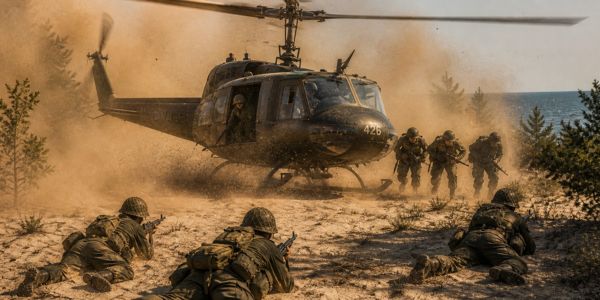
The helicopter came into view over the barracks in front of us. It descended gradually, in a graceful arch, and landed, nose facing us, more or less in the centre of the parade square. A circle of dust and dirt fanned out in a circle under it from the wash of the whirling blades atop the chopper. We stood, one line of four men, the other of three, and jogged to either side door of the Huey (a Bell UH-1 Iroquois). The crew chief already had them open and we scrambled inside. I couldn't hear anything due to the sound of the motor and the wind beating down on us from the rotating blades. All of our directions were given in hand signals.